
The Geopolitical Shift: Why Your 2026 GTM Strategy Is Already Obsolete With US Capturing Venezuela’s President. It’s a Turning Point for Global Economic Security
With the recent “capture” rather than kidnapping of the President of Venezuela at the start of 2026, the GTM (Go-To-Market) playbook for MSMEs prepared in 2025 has effectively become junk. The world order has fundamentally shifted. If you planned your GTM in 2025, you are no longer operating within the same geopolitical dynamics.
Why the Fall of Venezuela Matters: A State Interventionism Case Study
You may recall that on February 24, 2022, Russia invaded Ukraine, resulting in the deadliest conflict in Europe since World War II. While this was a major escalation of a conflict that began in 2014, many did not see it as a “red flag” for global stability at the time. In hindsight, it was the beginning of a new era of instability. The invasion was, to some extent, predictable based on military build-ups.
Today, however, we are not just dealing with the Russia-Ukraine conflict. Instead, we are managing multiple geopolitical “fuses.” We are seeing surprising disputes that were previously underreported:
- Border Tensions: Cambodia–Thailand and Rwanda–DRC.
- Proxy Interests: Saudi Arabia and the UAE’s friction over Yemen.
- Long-standing Conflicts: Israel–Palestine and North–South Korea.
- Emerging Flashpoints: Japan–China, China–Taiwan, and US intervention in Nigeria.
Consequently, the world has fractured into different, volatile facets.
The Trump Factor: How Much Does It Matter to Your GTM?
Lest we forget, Donald Trump is not a typical second-term president. He leads a powerful, business-polarised country and has consistently used tariffs as a weapon. Furthermore, he is the only president to have led the US the world’s largest capitalist nation to the brink of a civil war. This event was so severe that authorities had to evacuate Vice President Mike Pence for his safety. Additionally, his administration oversaw the longest government shutdown in US history (35 days, from December 2018 to January 2019).
Today, the administration is sacrificing US consumers and businesses under the pretext of tariffs and the “MAGA” agenda.
How This Affects Your Business Strategy: Agile GTM Requirements
If you are planning to expand your business to seek better opportunities, you must realise that turbulence has reached even “safe” markets like Nigeria. Previously, experts considered this a stable, budget-friendly destination. To protect your investments, you must look beyond traditional business metrics and evaluate the following:
1. Nuclear Deterrence and the NPT
Is the country a signatory of the Non-Proliferation Treaty (NPT), or does it possess a powerful nuclear deterrence?
- Nuclear-Weapon-Free Zones: Are they protected by international treaties?
- Nuclear Sharing: Do they have a nuclear-armed protector?
- Status: If a country lacks protection or deterrence, your investment faces the same risk of destabilisation as Venezuela. Safety and stability remain the prerequisites for long-term ROI.
In 2026, a nation’s NPT compliance or access to a nuclear-deterrence ‘umbrella’ serves as the ultimate guarantee of sovereign stability, protecting your long-term capital investments from the kind of rapid regime destabilisation seen in Venezuela.
2. Compartmentalized Alliances and Economic Decoupling
Modern alliances now dictate the “new rules for business” through sector-specific mini-laterals and transactional diplomacy. Unlike the broad, stable coalitions of the past, today’s alliances are often “compartmentalized.” For instance,a country might align with the US for defense and AI infrastructure while simultaneously maintaining deep trade ties with China for critical minerals or energy. This shift creates a fragmented regulatory environment where an MSME must navigate contradictory compliance regimes.
If you invest in a country that is part of a “security-led” alliance, your business may gain access to subsidies and protected markets in sectors like semiconductors or green tech. However, you also risk sudden “red-teaming” or exclusion from opposing blocs.
Furthermore, the rise of “hedge states” (like India, Saudi Arabia, and Brazil) has introduced a new layer of complexity. These nations prioritize “interest-based pragmatism” over rigid ideological loyalty. While this offers MSMEs a chance to capture incentives from multiple powers, it also means your GTM strategy must account for shifting trade corridors. As the US increasingly uses tariffs to enforce loyalty and China pivots to being a “net investor” in the Global South, the “allies” of your target market will determine everything from your currency stability to your supply chain resilience. In 2026, the critical question isn’t just “who are their friends?” but “how much will those friends cost your business if the wind changes?”
3. Supply Chain Decoupling and Shrinking Avenues
The “avenues” for business are shrinking due to the weaponization of trade infrastructure. We are seeing a shift from global open markets to a “patchwork” of bilateral deals and regional blocs. For an MSME, this means that even if a market like Nigeria or Cambodia has high demand for your product, the “avenues” to reach that demand logistics routes, payment gateways, and insurance coverage may be blocked or prohibitively expensive due to their geopolitical alignment.
A significant critical insight for 2026 is the “Secondary Sanction Trap.” As the US and China tighten their respective spheres of influence, doing business in one “avenue” (e.g., a Chinese-backed infrastructure project in Africa) can lead to your business being “blacklisted” or facing “red-teaming” in another (e.g., losing access to US-based cloud services or payment processors).
This environment forces MSMEs into a dangerous “all-or-nothing” strategy where they must choose a side, effectively cutting their potential global market reach by half. Moreover, as the world moves toward “National Security First” economies, avenues for physical goods are shrinking under heavy tariffs. This pressure forces a pivot toward digital services software, data, and engineering which remain more fluid but are increasingly targeted by new “digital sovereignty” laws.
4. Currency Devaluation – The 2026 “Margin Squeeze”
In 2026, Currency Devaluation has shifted from a cyclical economic hurdle to a permanent strategic risk for MSMEs. As of early 2026, we are witnessing a “de-synchronization” of global currencies. While the US Dollar experienced some depreciation in 2025, it remains the anchor of global trade. Consequently, its relative strength continues to squeeze emerging market (EM) currencies, which are hitting historic lows due to aggressive tariff policies and localized geopolitical shocks.
For MSMEs, the primary danger in 2026 is “Imported Inflation.” When a local currency devalues, the cost of raw materials, software licenses (typically priced in USD), and energy spikes instantly. This creates a “margin squeeze” where production costs rise in real-time, but local consumers’ purchasing power is shrinking, preventing businesses from raising prices without losing their market share.
Regional Case Studies of Devaluation
| Country | Currency Status (Early 2026) | Impact on MSME Operations |
| India | Rupee (INR) past 91 per USD | 80% of Indian MSMEs are import-dependent for raw materials; struggling to pass costs to consumers. |
| Nigeria | Naira (NGN) extreme volatility | High cost of imported packaging/machinery eroded margins to insolvency in regions like Gwagwalada. |
| Turkey | Lira (TRY) reached 40 per USD | Halted import trades for commodities like coal and polymers due to prohibitive dollar costs. |
| Egypt | EGP trading 52–55 per USD | Runaway inflation in food/fuel hitting the domestic MSME sector’s cost of operations. |
| Iran & Pakistan | “Confidence Recession” | In Iran, devaluations wipe out capital; in Pakistan, small businesses struggle to acquire credit. |
5. Election Meddling & Hybrid Warfare
The modern meddling landscape is characterised by “Hybrid Warfare” targeting economic institutions. In the 2026 cycle with significant elections in Colombia, Peru, Uganda, and the US Midterms interference often manifests as the targeted spreading of disinformation regarding a candidate’s fiscal policies or the hacking of government procurement systems.
For a business, this creates a “Confidence Vacuum.” When the legitimacy of an election is questioned (as we’ve seen in the US and parts of West Africa), domestic consumption drops. Furthermore, local banks often freese credit lines to MSMEs to hedge against potential post-election violence or radical policy shifts.
A critical insight for 2026 is the “External Veto.” Powerful nations now use meddling to ensure the “client” government remains loyal to specific trade blocs. If a foreign power successfully influences an election to install a leader who favors their “industrial policy” (e.g., exclusive mineral rights or high-tech export bans), an MSME that was previously aligned with the opposition’s trade agreements may find itself suddenly de-licensed or facing punitive audits.
The Meddling-to-Market Correlation
| Type of Meddling | Direct Impact on MSMEs | 2026 Example |
| Cyber-Sabotage | Hacking of tax portals or ONDC-like digital infrastructure. | Colombia: Targeted digital disruptions during the 2026 tax reform debates. |
| Disinformation Sprints | Spreading fake news about a business sector’s “unpatriotic” ties to foreign powers. | Nigeria/Uganda: Targeted smears against local tech firms as “foreign agents.” |
| Illicit Funding | Surge in “dark money” causes temporary, artificial local inflation and currency volatility. | Thailand: Fragile coalition shifts driven by offshore funding. |
| Institutional Erosion | Pressure on Central Bank independence (like the Fed) to lower rates for “political wins.” | United States: Increased volatility impacting 10-year Treasury yields and borrowing costs. |
6. Corruption and Bureaucracy (FATF Compliance Landscape)
A major critical insight for 2026 is that geographic location does not guarantee financial safety. In fact, we have seen a reversal of roles between traditional “high-risk” zones and emerging economies.
Key Country Highlights & Fact-Checks:
- Pakistan (The Success Story): Contrary to its long history on the list, Pakistan remains off the FATF Grey List in early 2026. Having been removed in late 2022, Pakistan has sustained its reforms in AML and CFT.
- Kenya (The New Entry): Kenya was placed on the FATF Grey List in early 2024 and remains there as of 2026.MSMEs in Nairobi report that “correspondent banking” has become a nightmare.
- Nigeria & South Africa (The Great Exit): In a major milestone, both Nigeria and South Africa were officially removed from the Grey List in late 2025. As a result, these are now “rebound markets” where investor confidence is surging.
- The “Black List” Hardliners: Countries like North Korea, Iran, and Myanmar remain on the FATF “Black List.” Doing business here is virtually impossible for a legitimate MSME.
Strategic Impact on Your GTM
| FATF Status | Countries (Early 2026) | Impact on Your MSME |
| Whitelisted | Pakistan, Nigeria, South Africa, UAE | Green Light: Standard due diligence; lower transaction costs. |
| Grey Listed | Kenya, Vietnam, Bulgaria, Venezuela | Yellow Light: Expect 15–30% higher compliance costs and KYC delays. |
| Black Listed | Iran, North Korea, Myanmar | Red Light: High risk of “Secondary Sanctions.” |
7. Sovereign AI and Data Residency Mandates
In 2026, governments treat data with the same protective intensity as physical borders. Many countries have moved from simple privacy laws (like GDPR) to strict Data Localization mandates.
- The “In-Country” Rule: Countries like Vietnam, India, and Indonesia increasingly require that you store sensitive data on physical servers within their borders.
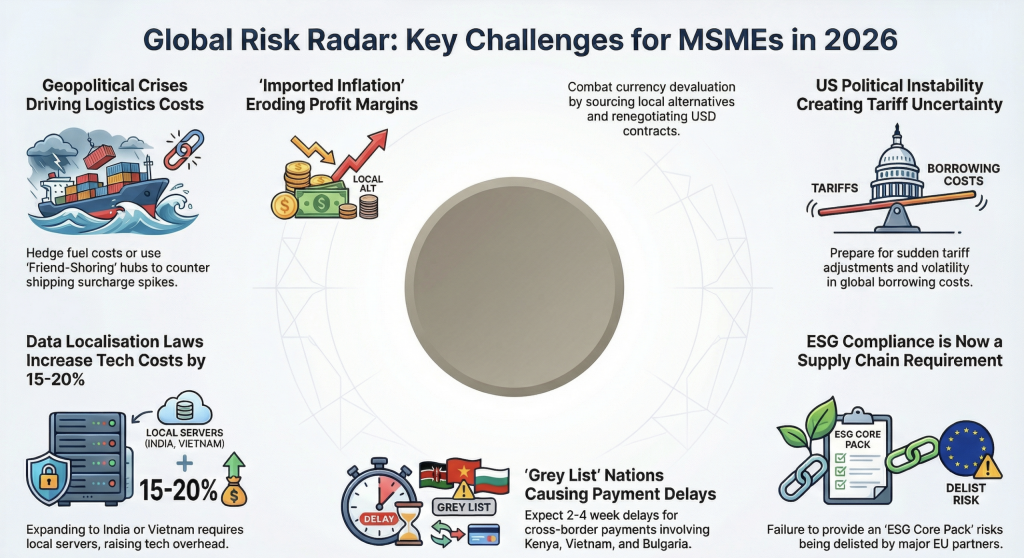
- Impact on GTM: If your MSME uses a centralised global cloud, you may be legally barred from operating in these markets. Therefore, you must now plan for “Multi-Local” infrastructure, which increases your tech overhead by 15–20% but is the only way to gain a “license to operate.”
8. Carbon-Sensitive Trade (The ESG Green Audit)
Environmental, Social, and Governance (ESG) compliance has shifted from a PR exercise to a hard requirement for entering global supply chains.
- The Trickle-Down Effect: Large multinational corporations (MNCs) are now legally required (under EU’s CSRD and CSDDD) to report on the carbon footprint and labor practices of their entire supply chain.
- The “Approved Vendor” Hurdle: If your MSME cannot provide an “ESG Core Pack” verifiable data on your energy usage, waste management, and fair labor you will be automatically disqualified from bidding for contracts with major global buyers in 2026.
9. Friend-Shoring Hubs and Supply Resilience
The “Just-in-Time” model of the last decade is dead. Today, the focus has shifted to “Just-in-Case” and “Friend-Shoring.”
- Geographic Diversification: Relying on a single manufacturing hub is now considered a high-risk failure.Successful GTMs utilize Near-Shoring moving production closer to the end consumer (e.g., US companies moving to Mexico, or European firms moving to Poland/Turkey).
- Automation as a Hedge: MSMEs are increasingly using robotics to offset the high labor costs of moving production back to “safe” or “allied” zones.
Summary of the Agile GTM
| New Factor | Critical Insight | Action for MSME |
| Sovereign AI | Local laws override global cloud convenience. | Audit data flow; ensure you can “ring-fence” data by territory. |
| ESG Compliance | Large buyers will audit your “Social” and “Green” credentials. | Create a “Sustainability Scorecard” to stay on approved lists. |
| Supply Resilience | Efficiency is secondary to continuity. | Diversify suppliers across at least two different “Alliance Blocs.” |
| Humanized AI | AI is the “Equalizer” for small teams. | Use AI for hyper-personalization to compete with scale. |
The 2026 GTM Strategic Checklist
Phase 1: The “Elimination” Filter (Selection Logic)
- The “Alliance Bloc” Check: Does the country belong to a trade bloc currently in a “Trade War” or facing heavy tariffs from your home country?
- FATF Status Audit: Is the country on the Grey List or newly cleared? Avoid Grey-Listed countries if you rely on low-cost wire transfers.
- Currency Volatility Ceiling: Has the local currency devalued by more than 15% in the last 12 months? If yes,ensure margins are at least 40%.
- Election Proximity: Is there a major national election scheduled in the next 6 months? (e.g., US Midterms).
Phase 2: The “Budget Efficiency” Checklist
- Data Residency Costs: Does the country require Data Localization? If they do, you need a local server budget.
- The “Free-Trade” Shortcut: Does your home country have a new 2025/2026 Trade Deal with this target? (e.g.,India-UK FTA).
- Digital Infrastructure Maturity: Does the country have a “Digital Public Infrastructure” (like India’s UPI/ONDC or Brazil’s Pix)?
- Labor Arbitrage vs. AI: Can you use local AI-driven customer support instead of hiring a full local team?
Phase 3: The “Go-Live” Operational Checklist
- The “Micro-Influencer” GTM: Instead of expensive ads, identify 10 local micro-influencers (10k–50k followers). In 2026, Niche Trust > Mass Reach.
- Hyper-Localization: Is your messaging translated in Cultural Context (e.g., “Bants” in the UK vs. “Jokes” in the US)?
- Regulatory “Sandbox” Entry: Does the country offer a “Regulatory Sandbox” for MSMEs? This allows testing with fewer licenses.
- ESG Scorecard: Do you have a basic one-page PDF showing your “Green” or “Social” impact?
The “Golden Rule” for 2026 MSME Expansion: “Test in a ‘Friend-Shoring’ Hub first.” If you are an Indian MSME, look at the UAE or Vietnam. If you are a US MSME, look at Mexico or Poland. These are “buffer zones” that are geopolitically stable.
How To Choose Go And No-Go Countries For Your Business
To navigate these decisions, the most critical step for an MSME is to move beyond generic data and engage with Industry-Specific Consultants. Consultants act as your geopolitical and regulatory “radar.”
Why Consultants are Your GTM “Secret Weapon” in 2026
| Challenge | How a Consultant Solves It |
| Hyper-Localization | They ensure your product fits local business etiquette and cultural nuances. |
| Regulatory Foresight | They predict “Salami-Slicing” bureaucracy before it hits your balance sheet. |
| Alliance Navigation | They help you place your business in the “correct” trade corridor (e.g., UAE vs. India-UK FTA). |
| FATF & Data Hurdles | They provide the technical workarounds for data localization or banking delays. |
Terms of Reference (ToR) Framework
Critical Questions to Ask Your GTM Consultant:
- Sector Specificity: “How does the 2026 rise in Green Tariffs specifically impact the margins for my product in Country X?”
- Geopolitical Resilience: “What is your ‘Plan B’ for our supply chain if the current Regional Conflict escalates?”
- Local Network: “Can you introduce us to three local ‘vetted’ partners who successfully navigated Country X?”
- Financial Mechanics: “Given the FATF status, what ‘Correspondent Banking’ pathways do you recommend?”
Navigating Regulatory Friction in 2026
We have framed these Frequently Asked Questions to address the seismic disruptions detailed in our analysis, “The Geopolitical Shift: Why Your 2026 GTM Strategy Is Already Obsolete.” Following the capture of Venezuela’s President in early 2026, the global order has fundamentally shifted, rendering 2025 business playbooks ineffective. Consequently, MSMEs must now navigate a landscape defined by state interventionism and volatile geopolitical dynamics. Furthermore, this transition serves as a critical turning point for global economic security. Therefore, the following insights provide definitive guidance for businesses forced to adapt their expansion strategies to this new, unstable reality.
1. How does the 2026 Venezuelan crisis affect global oil prices and MSME logistics?
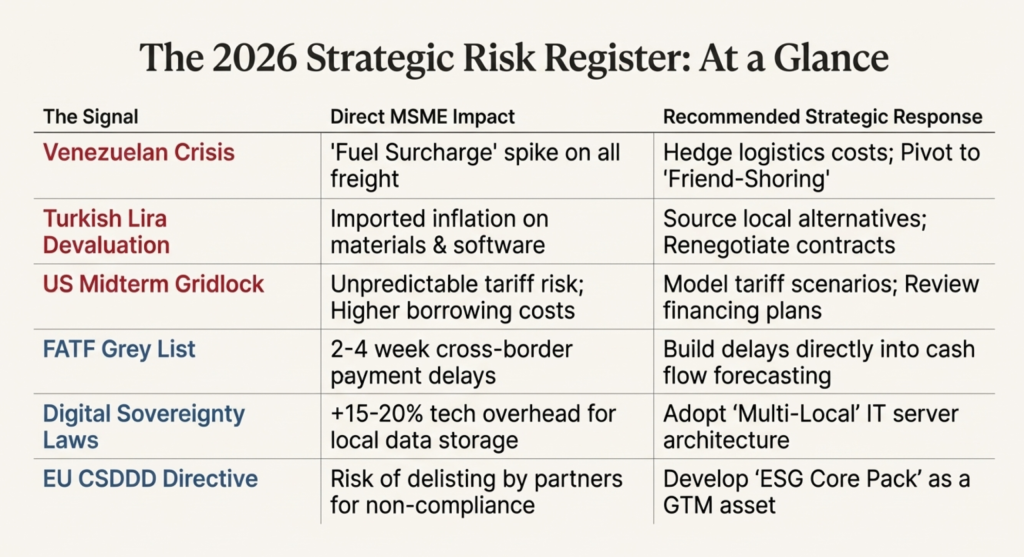
The capture of President Maduro by US forces in January 2026 triggered immediate volatility in energy markets. Consequently, MSMEs now face a “Fuel Surcharge” spike in shipping and air freight. If your GTM relies on thin margins, you must hedge your logistics costs immediately. Alternatively, you can pivot to “Friend-Shoring” hubs like Mexico or Poland to reduce transit distances.
2. Which countries are on the FATF Grey List as of early 2026?
As of January 2026, Kenya, Vietnam, and Bulgaria remain under increased monitoring on the Grey List. In contrast, authorities successfully removed Nigeria and South Africa in late 2025. For businesses, “Grey List” status necessitates mandatory Enhanced Due Diligence (EDD). As a result, this status often delays cross-border payments by two to four weeks.
3. What is “Imported Inflation” and how can MSMEs combat it in 2026?
Imported inflation occurs when a country’s currency devalues, which makes the cost of foreign raw materials and software licenses more expensive. For example, the Turkish Lira hit 40 per USD in March 2026. MSMEs should combat this pressure by sourcing local alternatives or renegotiating USD-denominated contracts. Furthermore, using “Multi-Local” pricing strategies can help protect your bottom line.
4. Why is Data Localization a requirement for expanding into India or Vietnam in 2026?
Both nations recently implemented strict “Digital Sovereignty” laws. Specifically, these rules require that firms store the personal and financial data of citizens on local servers. To comply, MSMEs must move away from centralized global clouds and adopt “Multi-Local” server architectures. Typically, this shift adds 15–20% to your total tech overhead.
5. How do the 2026 US Midterm Elections impact international trade policy?
The 2026 Midterms are currently creating a “Confidence Vacuum”. Because the US faces potential legislative gridlock, businesses are seeing a shift toward “Executive Order” governance. MSMEs should prepare for sudden tariff adjustments and increased volatility in Treasury yields. Notably, these shifts directly impact global borrowing costs for small enterprises.
6. Is ESG compliance mandatory for small businesses in 2026?
While the law does not always require compliance from the MSME itself, entering global supply chains practically demands it. Under the EU’s Corporate Sustainability Due Diligence Directive (CSDDD), large buyers now hold legal responsibility for their suppliers’ carbon footprints. If you cannot provide an “ESG Core Pack,” major international partners will likely delist your firm.
About the Author and LawCrust Global Consulting
This analysis was authored by N K Rao, a Hybrid Consultant at LawCrust Global Consulting. Specialised in the critical intersection of Management, Finance, and Legal domains, Rao advises Large and Mid-Size companies on high-stakes growth strategy, crisis management, and organizational transformation. His deep expertise in M&A and deal structuring allows him to navigate the complex regulatory and financial hurdles that define the 2026 trade landscape.
This Senior Consultant of LawCrust Global Consulting, embodies the firm’s pioneering Hybrid Consulting vertical. This integrated model is designed for the “businesses of the future,” breaking down the traditional silos between management, legal, finance, and technology consultants. By providing a holistic “quadrant” approach, LawCrust empowers MSMEs and global corporations to resolve complex challenges, ranging from litigation finance and receivables management to international expansion and debt restructuring. Under Rao’s strategic guidance and LawCrust’s innovative ecosystem, businesses gain more than just advice; they receive the execution-ready tools necessary to thrive in an era of global economic decoupling.
For expert business help, please contact us:
- Email: inquiry@lawcrustbusiness.com