
IT Company Insolvency: The Hard Truth When IT Firms Face Financial Crisis
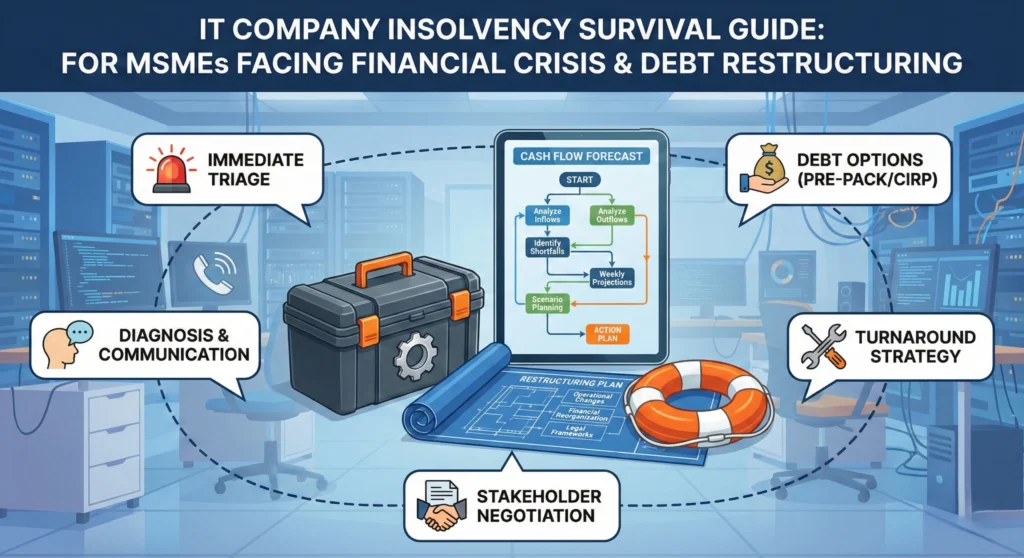
A survival guide for IT MSMEs navigating debt, cash flow collapse, and restructuring
The technology sector moves fast and so do financial crises when they hit. We’ve observed the full lifecycle of IT businesses, from meteoric growth to sudden collapse. What separates successful recovery from complete failure isn’t luck or timing it’s having the right strategic and legal framework to navigate insolvency before it’s too late.
Most IT company founders are brilliant technologists but have limited experience managing severe financial distress. When cash flow dries up, creditors start calling, and payroll becomes uncertain, panic sets in. Decisions made in those critical moments can either save the business or destroy any chance of recovery.
This isn’t theoretical. IT companies face unique insolvency risks that traditional businesses don’t encounter. Understanding these challenges and knowing when to seek expert intervention can mean the difference between strategic restructuring and catastrophic liquidation.
The IT Sector’s Unique Financial Vulnerabilities
IT companies operate differently from traditional businesses, and these differences create specific financial fragilities:
High Burn Rate, Unpredictable Revenue: Many IT companies, especially SaaS and product firms, burn significant capital while building products before generating consistent revenue. When funding dries up or customer acquisition stalls, the runway disappears fast.
Customer Concentration Risk: IT service companies often depend heavily on a few large clients. Losing a major account can instantly shift a profitable company into crisis. Unlike diversified businesses, recovery isn’t quick when 40-50% of revenue vanishes overnight.
Rapid Market Obsolescence: Technology changes fast. What was cutting-edge two years ago might be irrelevant today. Companies that fail to pivot or innovate can see their entire business model collapse, leaving them with debt but no viable path to revenue.
Working Capital Challenges: Many IT firms operate on tight margins with extended payment cycles. When clients delay payments or defaults occur, cash flow problems escalate quickly, making it impossible to cover operational expenses or debt obligations.
These aren’t abstract risks they’re the reality for thousands of IT MSMEs operating in competitive, fast-moving markets. When financial stress hits, it hits hard and fast.
The Four Key Stages of IT Company Insolvency
1. The Growth Phase Trap: Over-Leverage and Undercapitalisation
Growth can kill you. IT companies scaling aggressively often take on debt or dilute equity to fund expansion hiring teams, building infrastructure, and acquiring customers. When growth doesn’t materialise as projected or costs spiral beyond forecasts, the company ends up over-leveraged with insufficient revenue to service debt.
This is common in venture-backed startups that raise capital based on aggressive growth assumptions. When the next funding round doesn’t materialise and revenue projections miss, the company faces immediate liquidity pressure. Without expert intervention, founders try to “power through,” often making the problem worse by taking on more expensive debt or cutting critical investments.
2. Client Defaults and Revenue Collapse
IT service companies live and die by client relationships. When a major client goes into default, delays payment for months, or terminates contracts unexpectedly, the financial impact is immediate. Operational costs continue, salaries are due, but revenue has disappeared.
In these situations, companies scramble to replace lost revenue, often taking on unfavorable contracts just to keep cash flowing. This rarely works. The better path is structured financial restructuring that addresses the immediate liquidity crisis while preserving the business’s viability.
3. Technology Pivot Failures
Markets shift, and companies must adapt. But pivoting is expensive new product development, rebranding, customer re-acquisition and there’s no guarantee of success. IT companies that attempt pivots without adequate capital or a clear strategy often find themselves in a worse position: burning through reserves with no new revenue to show for it.
When a pivot fails and the company is left with debt obligations from the old business model but no viable path forward with the new one, insolvency becomes a real possibility. The question isn’t whether to restructure, but how to do it in a way that preserves value for stakeholders.
4. Regulatory and Compliance Crises
IT companies, especially those handling data, payments, or operating in regulated sectors like fintech or healthtech, face significant compliance burdens. A regulatory violation, data breach, or compliance failure can trigger massive fines, legal costs, and client attrition all of which can push a financially healthy company into crisis.
When legal liabilities exceed available capital, companies must act quickly to manage creditor claims, negotiate settlements, and restructure operations to prevent total collapse.
The Solutions: Strategic Insolvency and Restructuring for IT Companies
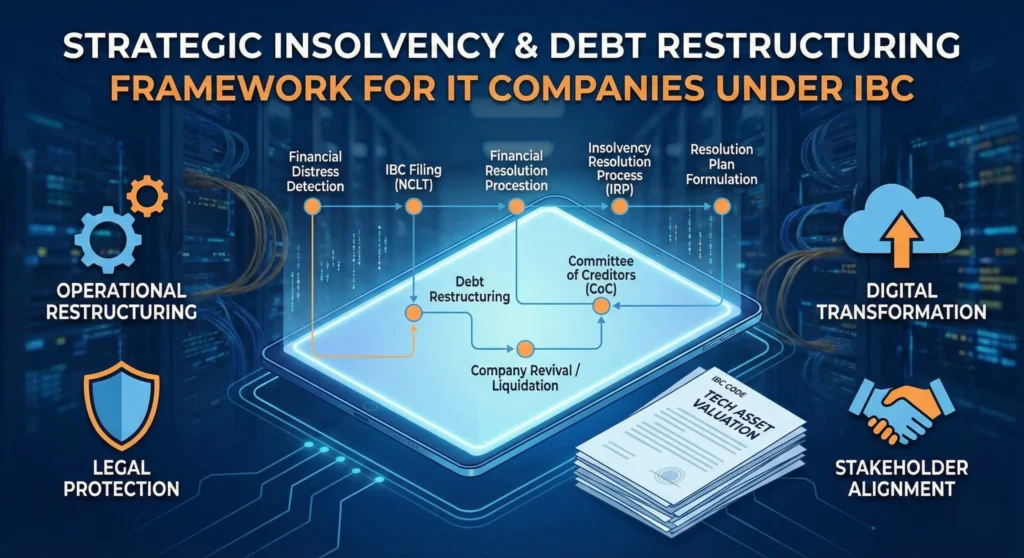
Insolvency doesn’t have to mean the end. The modern insolvency framework, particularly under India’s Insolvency and Bankruptcy Code (IBC), is designed to facilitate recovery and restructuring, not just liquidation. For IT companies, the goal is to preserve the valuable components of the business IP, client relationships, technology assets while addressing unsustainable debt.
Here’s how strategic approaches make the difference:
Immediate Crisis Management and Stabilisation
When financial distress hits, the first priority is stabilisation. This means securing critical assets, managing creditor pressure, and ensuring operational continuity. The immediate focus should be on assessing the situation, implementing cash flow controls, and opening lines of communication with creditors to prevent aggressive collection actions that could force premature liquidation.
This phase is about buying time and creating space for strategic decision-making rather than reactive crisis management.
Debt Restructuring and Negotiation
Not all debt needs to be repaid immediately. Through strategic negotiation, it’s possible to restructure obligations extending payment terms, reducing principal, converting debt to equity, or securing standstill agreements. For IT companies with viable business models but temporary liquidity issues, restructuring can provide the breathing room needed to recover.
The key is demonstrating to creditors that restructuring offers better recovery than liquidation. IT companies often have intangible assets (IP, software, customer contracts) that lose value in liquidation but retain significant worth in a going concern. The challenge is articulating this value and negotiating terms that benefit all parties.
Operational Turnaround and Business Restructuring
Financial restructuring alone isn’t enough. IT companies must also address the operational issues that led to distress. This might involve cutting unprofitable service lines, renegotiating vendor contracts, optimising team structures, or pivoting to more profitable market segments.
The goal is designing and implementing turnaround strategies that align financial realities with operational capabilities, ensuring the restructured business is positioned for sustainable profitability.
Asset Valuation and Maximisation
In insolvency scenarios, accurate asset valuation is critical. IT companies often possess valuable intangible assets proprietary technology, customer databases, software licenses, brand equity that require expert valuation to maximise recovery.
Whether the outcome is restructuring or controlled liquidation, ensuring assets are properly valued and monetised protects stakeholder interests and maximises outcomes.
Stakeholder Alignment and Communication
Insolvency involves multiple parties creditors, employees, clients, investors, and regulators. Managing these relationships requires transparency, strategic communication, and alignment of interests. Facilitating negotiations, managing expectations, and ensuring all parties understand the restructuring plan and their role in it becomes essential.
Effective stakeholder management reduces disputes, accelerates resolution, and increases the likelihood of successful restructuring.
What Makes the Difference: The Integration Factor
Insolvency and restructuring for IT companies isn’t a one-size-fits-all legal process. It’s a complex transformation. At Solvencis, we bridge the gap between traditional restructuring and the high-speed reality of the tech sector.
1. Integrated Sector Expertise
Traditional firms often lack the tech-DNA needed to handle an IT business. We provide a comprehensive approach that merges:
- Legal Frameworks: Expertly navigating debt restructuring and creditor negotiations.
- Technology Realities: Understanding SaaS economics, IP valuation, and technology lifecycle management.
- Sector Nuance: We speak your language from client concentration risks to enterprise software cycles.
2. Cross-Functional Coordination
The most effective resolutions happen when experts work together, not in silos. Our model brings three critical disciplines under one roof:
- Legal: Navigating the IBC and regulatory compliance.
- Financial: Analysing cash flow and restructuring debt obligations.
- Operational: Ensuring the business continues to function during the transition.
3. Enterprise-Grade Support for MSMEs
Large consulting firms often ignore Small and Medium Enterprises, but we believe MSMEs deserve the same level of expertise as global giants.
- Accessibility: customised engagement models designed specifically for IT MSMEs.
- Affordability: Expert support that doesn’t add to your financial burden.
- Focus: Dedicated attention to companies that are often overlooked by “The Big Four.”
4. Partnership-Based Execution
We don’t just hand over a plan and walk away; we walk the path with you. Our focus is on:
- Stress Reduction: Providing a clear roadmap to take the weight off your shoulders.
- Jargon-Free Communication: Explaining legal and financial options in plain English.
- Transparent Decision-Making: Ensuring founders understand every step of the process.
FAQ
1. Does insolvency automatically mean my IT company will shut down?
No. Insolvency does not automatically lead to liquidation. Modern insolvency frameworks, including India’s Insolvency and Bankruptcy Code (IBC), are designed to enable restructuring and business recovery wherever possible. Many IT companies successfully continue operations through debt restructuring, operational turnaround, or strategic resolution plans.
2. When should an IT company seek insolvency or restructuring support?
The right time is before cash flow collapses completely. Warning signs include delayed salary payments, mounting creditor pressure, repeated loan rollovers, client payment defaults, or sustained operating losses. Early intervention significantly increases the chances of recovery and preserves more strategic options.
3. Can intangible assets like software and IP really help during insolvency?
Yes. For IT companies, intangible assets such as proprietary software, source code, client contracts, databases, and brand equity often hold more value than physical assets. When properly valued and presented, these assets can play a critical role in restructuring negotiations and improving creditor recovery outcomes.
4. How is insolvency for IT companies different from traditional businesses?
IT insolvency involves unique challenges SaaS economics, client concentration risk, fast technology obsolescence, and IP valuation. Standard restructuring approaches often fail because they don’t account for these factors. Effective IT insolvency resolution requires advisors who understand both technology business models and legal restructuring frameworks.
5. What are the biggest mistakes founders make during financial distress?
The most common mistakes are delaying action, avoiding creditor communication, taking expensive short-term debt to survive, and attempting pivots without sufficient capital or strategy. Panic-driven decisions often destroy value. Strategic, informed intervention almost always leads to better outcomes.
Final Thoughts: Act Early, Act Strategically
If your IT company is facing financial distress mounting debt, cash flow problems, creditor pressure, or operational losses the worst thing you can do is wait. The earlier you engage expert restructuring support, the more options you have.
Strategic insolvency consulting isn’t about giving up on your business. It’s about saving what can be saved, restructuring what must be restructured, and positioning your company for recovery. The companies that emerge from financial crises successfully are the ones that acted decisively, engaged expert support, and executed a clear restructuring plan.
The difference between strategic restructuring and catastrophic liquidation often comes down to timing and expertise.
About Solvencis
Solvencis delivers Hybrid Consulting Solutions in Management, Finance, Technology, and Legal Consulting to IT businesses worldwide. We specialise in Insolvency & Bankruptcy Consulting, helping IT companies navigate financial distress through strategic restructuring and recovery planning.
For more information Email: inquiry@solvencis.com