
Why Most IT M&A Deals Fail (And How to Be in the 30% That Succeed)
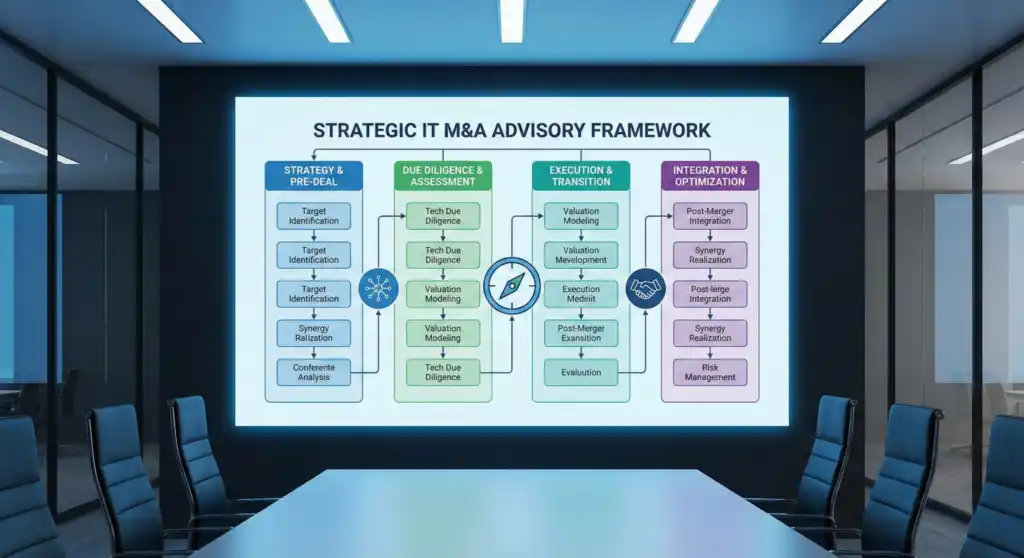
An essential guide for IT companies navigating mergers, acquisitions, and strategic exits
IT mergers and acquisitions present a fascinating paradox. On paper, they should create significant value combined capabilities, expanded market reach, cost synergies, and accelerated growth. In reality, most M&A deals fail to deliver their promised value. We’ve witnessed this from every angle: sellers who walked away with disappointing valuations, buyers who overpaid for underperforming assets, and post-merger integrations that destroyed value instead of creating it.
The IT sector is particularly challenging for M&A. Unlike traditional industries where assets are tangible and value is easier to assess, IT deals revolve around intangibles technology, talent, customer relationships, and intellectual property. These assets can evaporate overnight if not properly valued, transitioned, and integrated.
Here’s the uncomfortable reality: having great technology or a strong client base doesn’t automatically translate to a successful M&A outcome. The companies that maximise value in M&A transactions are the ones that understand the unique complexities of IT deals and approach them with strategic rigor, not optimistic assumptions.
The IT Sector’s Unique M&A Landscape
IT companies face distinct M&A dynamics that don’t exist in traditional sectors:
- Intangible Asset Concentration: The majority of an IT company’s value resides in intangible assets proprietary software, patents, customer data, brand reputation, and human capital. These assets are difficult to value and even harder to transfer seamlessly.
- Rapid Technology Obsolescence: Technology lifecycles are short. An acquisition target with cutting-edge technology today might own obsolete code in two years. Buyers must assess not just current capabilities but the sustainability and scalability of the technology stack.
- Talent Retention Risk: In IT companies, the value walks out the door every evening. Key engineers, product managers, and customer relationship owners are often the primary value drivers. If they leave post-acquisition, the deal value collapses.
- Customer Concentration and Churn: Many IT service companies depend heavily on a few large clients or have subscription-based revenue models susceptible to churn. Understanding customer stickiness, contract terms, and renewal rates is critical to accurate valuation.
- Cultural Integration Challenges: IT companies often have strong, distinct cultures especially startups and product companies. Poor cultural fit between acquirer and target can lead to talent exodus, productivity declines, and strategic failure.
These aren’t theoretical concerns they’re the reasons why so many IT M&A deals fail to deliver promised synergies.
The Four Critical Challenges in IT M&A Transactions
1. Valuation Discrepancies and Unrealistic Expectations
This is where most IT M&A deals start to go wrong. Sellers, especially founders, often have emotionally inflated expectations about their company’s value. They see years of effort, sleepless nights, and technological innovation and believe buyers should pay a premium for that story.
Buyers, meanwhile, are focused on hard numbers revenue multiples, EBITDA, customer acquisition costs, churn rates, and defensibility of competitive position. When these perspectives clash, deals either don’t close or close at valuations that leave one party feeling shortchanged.
The problem is compounded in the IT sector because traditional valuation methods don’t always capture the full picture. How do you value proprietary AI algorithms? What’s the worth of a talented but small engineering team? What premium should be paid for a strong brand in a niche market? Without expert advisory support, these valuation gaps become deal-breakers.
2. Inadequate Due Diligence on Technology and IP
Buyers often conduct financial and legal due diligence but underinvest in technology due diligence. This is a critical mistake in IT M&A. Questions that must be answered include:
- Is the codebase maintainable and scalable, or is it technical debt waiting to explode?
- Are there IP ownership issues did contractors retain rights, or is there open-source code that creates licensing risks?
- What’s the technology’s competitive moat? Can it be easily replicated or is it genuinely differentiated?
- Are there security vulnerabilities, data privacy compliance issues, or regulatory risks?
Deals have closed only for buyers to discover post-acquisition that the “proprietary technology” was built on freely available open-source frameworks with minimal differentiation, or that key IP was never formally transferred to the company. These discoveries destroy deal value and create costly post-merger problems.
3. Cultural Misalignment and Talent Exodus
IT companies are people businesses. The moment an acquisition is announced, key employees start evaluating their options. If the acquiring company’s culture, values, or operational style clashes with the target, talent leaves. And when talent leaves, so does the value.
This is especially true in product companies and startups where the founding team and early employees hold critical institutional knowledge, customer relationships, and technical expertise. If these individuals don’t buy into the acquisition vision or don’t see a clear path for themselves in the new entity, they’ll exit often taking clients or starting competitive ventures.
Successful IT M&A requires proactive talent retention strategies, clear communication, and cultural integration planning not just financial terms.
4. Post-Merger Integration Failures
The deal closes, the press release goes out, and then… chaos. Systems don’t integrate, teams work in silos, customers get confused about points of contact, and operational inefficiencies multiply. This is the reality of most post-merger integrations.
In IT M&A, integration challenges are amplified because you’re merging not just companies but technology stacks, development methodologies, customer support systems, and product roadmaps. Without a clear integration plan executed from day one, the anticipated synergies cost savings, cross-selling opportunities, combined capabilities never materialise.
The result? The acquisition becomes a value-destroying distraction rather than a strategic growth catalyst.
The Solutions: Strategic M&A Advisory for IT Companies
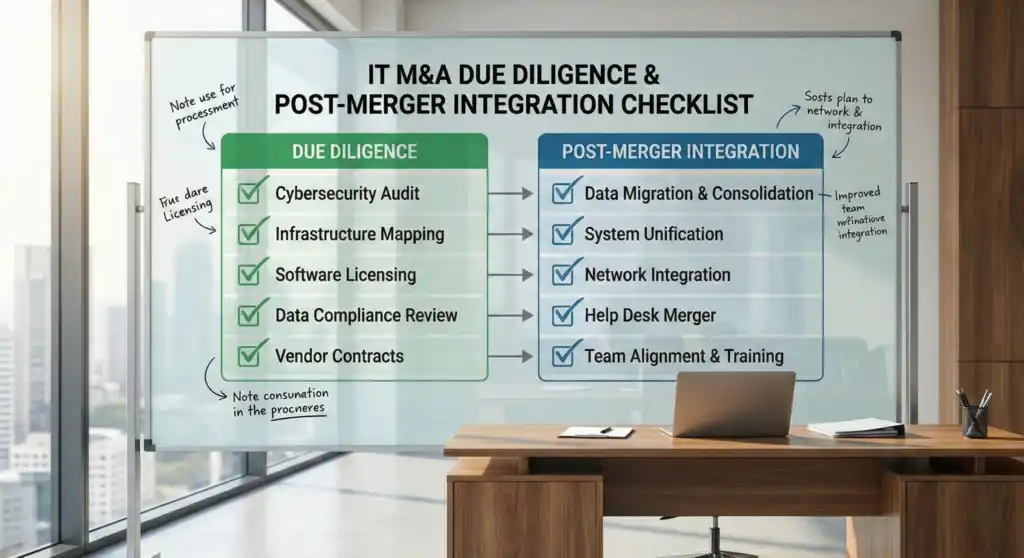
Successful IT M&A isn’t luck it’s the result of strategic planning, rigorous due diligence, and expert execution. Here’s how professional M&A advisory changes outcomes:
Accurate Valuation and Deal Structuring
Both buyers and sellers need to arrive at fair, defensible valuations based on rigorous financial analysis, market comparables, technology assessments, and growth projections. For sellers, this means understanding what your company is actually worth to potential acquirers and positioning it to maximise value. For buyers, it means avoiding overpayment and structuring deals with appropriate risk protections earnouts, escrows, and performance milestones.
Proper deal structuring also addresses tax implications, payment terms, and transition arrangements to ensure all parties achieve their objectives.
Comprehensive Technology and IP Due Diligence
Deep technology assessments go beyond surface-level reviews. This includes code audits, IP verification, security assessments, scalability analysis, and competitive positioning evaluation. For buyers, this protects against hidden risks. For sellers, proactive technology due diligence identifies and resolves issues before they become deal obstacles.
Understanding what you’re actually buying or selling not what you assume is the foundation of successful IT M&A.
Talent Retention and Cultural Integration Planning
Acquirers need retention strategies that keep key talent engaged and committed. This includes identifying critical personnel, designing incentive structures, clarifying roles and career paths, and facilitating cultural alignment workshops. The goal is to make the transition a career opportunity, not a career threat, for top performers.
For sellers, this means ensuring your team understands the deal rationale and their role in the combined entity, reducing uncertainty and preventing premature exits.
Post-Merger Integration Roadmaps
Detailed integration plans must address technology consolidation, customer communication, operational alignment, and performance monitoring. Clear timelines, ownership, and success metrics ensure integration doesn’t become an endless, value-destroying process.
Effective integration turns two separate companies into one stronger entity rather than creating a dysfunctional merger that underperforms both legacy businesses.
Regulatory and Compliance Navigation
IT M&A often involves complex regulatory considerations data privacy laws, cross-border transactions, IP licensing, employment regulations, and industry-specific compliance. Ensuring all legal and regulatory requirements are met avoids penalties, delays, or deal failures.
What Makes the Difference: The Integration Factor
M&A advisory for IT companies isn’t a commodity service it’s a comprehensive business transformation. At Solvencis, we move beyond the spreadsheet to ensure that technical value, operational synergy, and financial strategy are perfectly aligned.
1. Integrated Sector Expertise
Traditional advisory firms often treat M&A as a purely financial transaction. We provide a specialised approach that understands the unique DNA of the technology sector:
- Technology Realities: Deep-dive assessments of code quality, IP ownership, security posture, and scalability.
- Sector Nuance: Understanding the specific value drivers of IT business models, from SaaS metrics to enterprise technology stacks.
- Beyond Finance: Integrating technical due diligence with traditional financial analysis to ensure no hidden risks are overlooked.
2. Cross-Functional Coordination
A successful deal requires more than just a signed contract; it requires harmony across multiple domains. Our model ensures that every discipline works in lockstep:
- Legal & Financial: Coordinating complex negotiations while securing the best financial terms.
- Operational & Technology: Aligning business processes and tech stacks to ensure the combined entity can actually perform.
- Integrated Strategy: Managing the deal as a holistic transformation rather than a series of isolated tasks.
3. Enterprise-Grade Support for MSMEs
While large investment banks often ignore small and mid-sized IT deals, we believe growth-stage companies deserve the same caliber of expertise as global enterprises:
- Accessibility: Engagement models specifically designed for IT MSMEs and growing tech firms.
- Affordability: Providing high-level expertise through a structure that makes sense for mid-market valuations.
- Expert Focus: Bringing “Big Bank” sophistication to the companies that traditional firms overlook.
4. End-to-End Partnership
The most successful outcomes happen when advisors stay for the whole journey. We view deal closure as the midpoint, not the finish line:
- Continuous Support: From initial target identification and due diligence through to post-merger integration (PMI).
- Value Realisation: Focusing on the post-closure phase, where the actual value of the merger is either realised or lost.
- Jargon-Free Clarity: Providing transparent communication and clear explanations of trade-offs so founders can make informed decisions.
Final Thoughts: M&A is Strategic, Not Transactional
If you’re an IT company considering an acquisition, sale, or merger, the most dangerous assumption you can make is that the deal will “just work out.” It won’t not without strategic planning, rigorous due diligence, and expert execution.
M&A is a strategic tool for growth, market expansion, talent acquisition, or exit. But it’s also a high-risk endeavor where poor planning and execution destroy value. The companies that succeed in M&A are the ones that treat it as a strategic initiative requiring expert guidance, not just a financial transaction.
Success in IT M&A comes down to understanding the unique complexities of technology deals and approaching them with the right combination of sector expertise, integrated capabilities, and execution discipline.
FAQ
1. Why do most IT M&A deals fail despite strong technology and revenue?
Because M&A success depends less on technology quality and more on execution. Most failures stem from unrealistic valuations, weak technology due diligence, cultural misalignment, talent attrition, and poor post-merger integration. In IT deals, intangible assets lose value quickly if not managed strategically.
2. How is IT M&A different from M&A in traditional industries?
IT M&A is driven by intangible assets—software, IP, talent, and customer relationships—rather than physical assets. These assets are harder to value, transfer, and retain. Additionally, rapid technology obsolescence, subscription revenue risks, and talent dependency make IT transactions significantly more complex.
3. What role does technology due diligence play in IT acquisitions?
Technology due diligence is critical. It evaluates code quality, scalability, security, IP ownership, licensing risks, and long-term viability of the technology stack. Many IT deals fail post-close because buyers discover technical debt, IP gaps, or compliance issues that weren’t identified during diligence.
4. How can founders and key employees be retained after an acquisition?
Retention requires early planning and clear communication. Successful deals include incentive structures, defined career paths, cultural alignment initiatives, and leadership continuity. When employees understand the vision and see growth opportunities, talent retention improves and deal value is preserved.
5. What determines whether an IT M&A deal creates or destroys value?
Value creation depends on integrated execution across valuation, due diligence, deal structuring, and post-merger integration. Deals succeed when buyers and sellers align strategically, risks are properly priced, integration is planned before closing, and advisors understand both technology and business realities.
About Solvencis
Solvencis delivers Hybrid Consulting Solutions in Management, Finance, Technology, and Legal Consulting to IT businesses worldwide. We specialise in Mergers & Acquisitions Consulting, helping IT companies navigate complex transactions from strategy through post-merger integration.
For more information Email: inquiry@solvencis.com