
Unlocking Pharma M&A Success: A Strategic Guide for the Industry
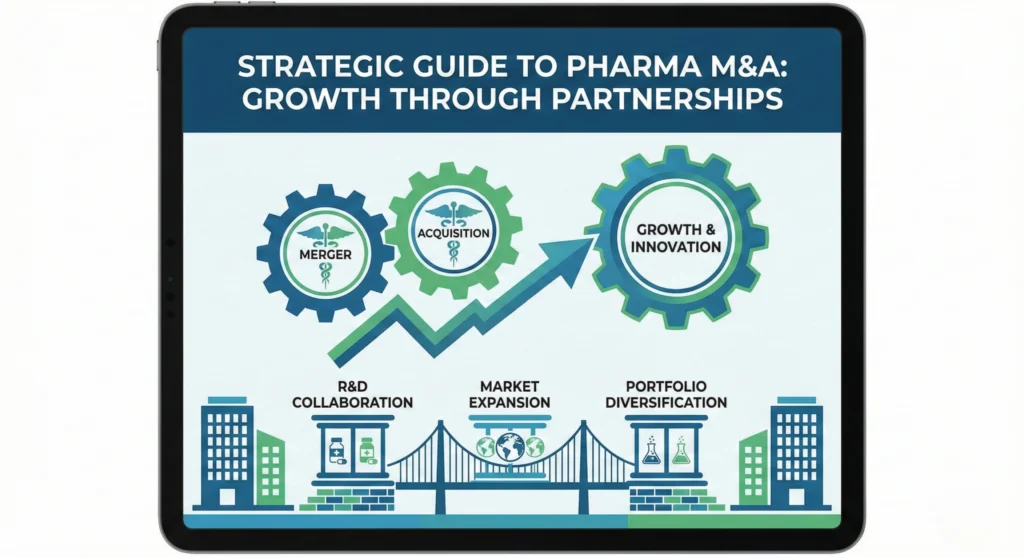
The pharmaceutical industry is experiencing a remarkable era of growth through strategic partnerships and acquisitions. In 2024 alone, pharma companies worldwide invested over $180 billion in M&A activities acquiring innovative technologies, expanding therapeutic portfolios, and building stronger market positions.
This wave of consolidation isn’t just about deal-making; it’s about accessing breakthrough science, accelerating drug development, and ultimately bringing life-changing treatments to patients faster.
M&A has become the preferred growth strategy for forward-thinking pharma companies. Why? Because the path to building a robust pipeline internally is long and capital-intensive. Smart acquisitions can compress decades of development into strategic transactions, giving companies immediate access to promising molecules, cutting-edge platforms, and established market infrastructure.
However, success in pharma M&A requires more than financial resources it demands specialised expertise that bridges science, regulation, and commercial strategy. Companies that approach M&A with the right knowledge and support consistently outperform those that treat it as a purely financial exercise.
The Strategic Value: Why M&A Drives Pharma Growth
Pharmaceutical M&A isn’t just a trend it’s a strategic imperative driven by powerful business opportunities:
- Accelerating Innovation: Instead of spending $2.6 billion and 10–15 years developing a drug from scratch, companies can acquire late-stage assets and bring them to market faster. This acceleration benefits patients, shareholders, and healthcare systems alike.
- Building Pipeline Strength: A diverse pipeline reduces risk and creates multiple pathways to growth. M&A allows companies to quickly strengthen their development portfolios with proven molecules and promising early-stage assets.
- Expanding Therapeutic Reach: Companies can strategically enter high-growth therapeutic areas like oncology, rare diseases, or gene therapy by acquiring specialised players rather than building expertise from zero. This creates immediate credibility and market presence.
- Accessing New Markets: Established relationships with regulators, key opinion leaders, and payer organisations are invaluable. Acquiring companies with strong market presence opens doors that would otherwise take years to unlock.
- Capturing Breakthrough Technologies: Revolutionary platforms in gene therapy, mRNA technology, and AI-driven drug discovery are reshaping pharma. Acquiring these capabilities early provides a competitive advantage that compounds over time.
The opportunity is clear. The question is: how do successful companies navigate the complexities to realise this value?
Key Considerations for Pharma M&A Success
While the opportunities are significant, pharma M&A does have unique complexities that require careful navigation. Understanding these factors upfront allows companies to plan effectively and maximise deal value. Here are the critical areas that deserve attention:
1. Managing Development and Regulatory Timelines
Pharma M&A involves acquiring assets at various development stages. The key is thorough evaluation of clinical data, regulatory pathways, and approval timelines across different markets. Successful acquirers work closely with regulatory experts to map out realistic scenarios and build contingency plans. They also engage early with payer organisations to understand reimbursement requirements, ensuring commercial viability alongside regulatory approval.
2. Strategic Valuation and Deal Structuring
Pricing innovative pharma assets requires specialised expertise you’re valuing future potential based on clinical data, market dynamics, and competitive landscapes. Smart deal structures balance upfront payments with milestone-based earnouts, aligning seller and buyer interests. The most successful deals involve realistic projections, thorough competitive analysis, and creative structures that protect both parties while incentivising success.
3. Cultural Integration and Talent Retention
One of the greatest opportunities in pharma M&A is accessing talented scientific teams and innovative cultures. The challenge is preserving what made the acquired company special while providing the resources and scale of the larger organisation. Leading companies create integration plans that respect both cultures, retain key talent through meaningful incentives, and maintain the entrepreneurial spirit that drives innovation.
4. Intellectual Property and Patent Strategy
Strong IP due diligence is essential in pharma transactions. This includes evaluating not just the core patents but also formulation IP, delivery mechanisms, and manufacturing processes. Successful acquirers conduct comprehensive freedom-to-operate analyses and develop strategies to maximise patent life through lifecycle management, label expansions, and new formulations.
5. Commercial Readiness and Market Access
The transition from regulatory approval to commercial success requires careful preparation. This includes building relationships with key opinion leaders, engaging patient advocacy groups, designing real-world evidence studies, and developing payer value propositions. Companies that invest in commercial infrastructure before launch consistently achieve better outcomes.
How Specialised Expertise Drives M&A Success
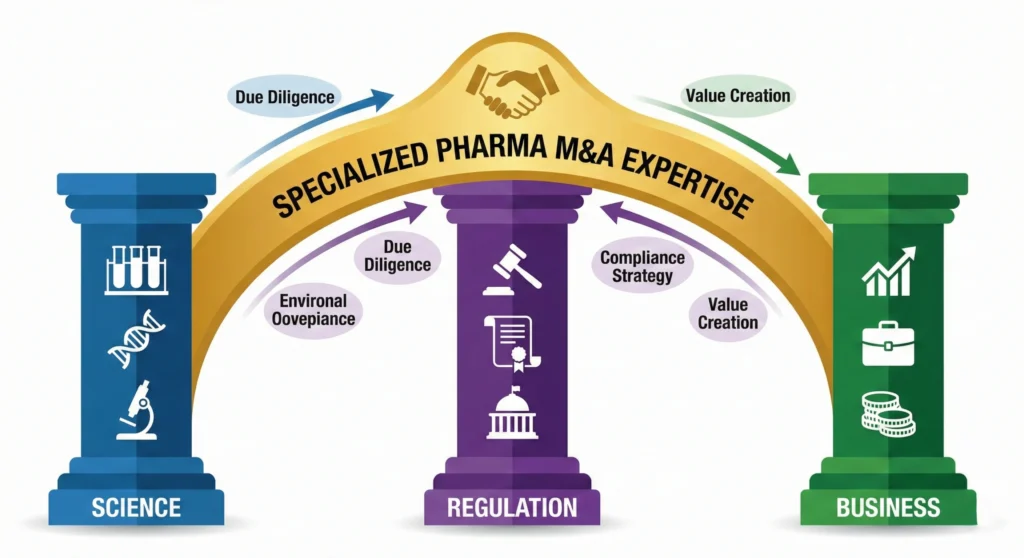
The difference between good and great pharma M&A outcomes often comes down to having the right advisory partner one with deep industry knowledge and practical execution capabilities.
Comprehensive Due Diligence
- Regulatory risk assessment across multiple markets
- Clinical trial design review and success probability analysis
- Manufacturing feasibility and supply chain evaluation
- Market access and payer landscape mapping
- IP portfolio analysis and freedom-to-operate studies
Strategic Integration Planning
- Cultural assessment and talent retention strategies
- Phased integration roadmaps that preserve innovation
- Manufacturing transfer and technology adoption plans
- Sales force optimisation and go-to-market alignment
Regulatory and Market Access Strategy
- Scenario planning for different regulatory outcomes
- Early payer engagement and value demonstration
- Real-world evidence study design
- Pricing strategy development
Operational Excellence
- Manufacturing partner identification and qualification
- Supply chain redundancy and risk mitigation
- Post-merger performance monitoring and course correction
The Solvencis Advantage in Pharma M&A
At Solvencis, we bring a complete approach to pharma M&A integrating transaction advisory with go-to-market strategy, operational consulting, and regulatory expertise. Our team understands that successful deals require more than closing; they require execution excellence in the months and years that follow.
Our M&A Capabilities:
- Buy-Side Advisory: We help identify strategic acquisition targets, conduct multi-dimensional due diligence, and structure deals that optimise value while managing risk.
- Sell-Side Advisory: For biotech founders and mid-sized pharma companies, we position assets effectively, manage the diligence process, and negotiate optimal terms.
- Joint Venture Structuring: We design partnership arrangements for co-development and co-commercialisation that align incentives and share risks appropriately.
- Integration Support: Our operational expertise ensures smooth technology transfer, cultural integration, and preservation of key talent and innovation capabilities.
- Regulatory Strategy: We navigate complex regulatory pathways across jurisdictions, plan for multiple scenarios, and optimise approval timelines.
- Commercial Readiness: We develop go-to-market strategies, build payer value propositions, and establish market access infrastructure before launch.
- Crisis Management: When deals face challenges, we provide turnaround services including brand repositioning, operational restructuring, and strategic pivots.
What distinguishes our approach is the integration of M&A advisory with manufacturing expertise, regulatory intelligence, and commercial execution. Pharma M&A sits at the intersection of science, business, and regulation, and our approach reflects that reality.
The Future of Pharma M&A: Emerging Opportunities
The pharmaceutical landscape continues to evolve with exciting developments in cell and gene therapies, personalised medicine, and digital therapeutics. These innovations are creating new M&A opportunities as companies seek to build capabilities in next-generation treatments. The convergence of pharma with technology, diagnostics, and data analytics is opening entirely new deal structures and partnership models.
Forward-thinking companies are positioning themselves to capitalise on these trends. They are doing so not only through traditional acquisitions, but also through strategic partnerships, platform acquisitions, and ecosystem building. The key is approaching M&A as a transformation tool rather than just a transaction.
FAQ
Why do so many pharmaceutical M&A deals fail?
Nearly half of pharma M&A deals fail due to high development risk, overpayment, integration issues, IP challenges, and market access barriers. These risks are intensified by strict regulations, long timelines, and uncertainty over drug approval.
When should a pharma company consider M&A as a growth strategy?
Pharma companies pursue M&A to fill pipeline gaps, offset patent cliffs, enter new therapeutic areas, and gain access to new markets or advanced technologies. It is often faster and more cost-effective than internal drug development, which takes 10–15 years and costs about $2.6 billion per drug.
What makes pharma M&A different from other industries?
Pharma M&A is uniquely complex because you’re buying assets (drugs) that might never reach the market due to regulatory failures or safety issues. The industry faces strict regulations across different countries, requires insurance and government approval for payment, depends heavily on patents and intellectual property, and involves highly specialised manufacturing processes. Additionally, the scientific and entrepreneurial culture of biotech companies often clashes with large pharma corporate structures, making integration particularly challenging.
How can we ensure our pharma M&A deal succeeds?
Success requires three key elements: comprehensive due diligence that goes beyond financials to include regulatory risk assessment, clinical trial review, manufacturing feasibility, and market access mapping; integration planning that starts during the evaluation phase, not after deal closure; and specialised pharma M&A expertise that understands the intersection of science, business, and regulation. Companies also need to maintain realistic valuations, plan for multiple regulatory scenarios, and ensure commercial readiness including relationships with key opinion leaders and payer organisations.
What support does Solvencis provide for pharma M&A?
Solvencis offers end-to-end pharma M&A support including buy-side advisory (finding and evaluating acquisition targets), sell-side advisory (positioning biotech assets for optimal exit), joint venture structuring (partnership arrangements for co-development), crisis management and turnaround services (fixing underperforming deals), legal and regulatory compliance across jurisdictions, and financial restructuring. Our approach integrates M&A advisory with go-to-market strategy, manufacturing partner selection, and operational consulting to ensure deals deliver value not just at closure, but in the months and years afterward.
Conclusion: Building Success Through Strategic M&A
Pharmaceutical M&A represents one of the most powerful growth strategies available to companies today. It accelerates innovation, strengthens pipelines, expands market reach, and provides access to breakthrough technologies that can transform patient care.
The Three Essential Elements of Success:
- Comprehensive evaluation that examines all aspects of value creation.
- Thoughtful planning that begins during due diligence.
- Expert execution that addresses the unique dynamics of pharmaceutical business.
The Path to Optimal Outcomes: The companies achieving the best M&A outcomes are those that combine strategic vision with operational excellence understanding not just what to acquire, but how to integrate, scale, and commercialise effectively. They recognise that while the transaction is important, the real value creation happens in the execution that follows.
The Opportunity for Growth: Whether you aim to strengthen your pipeline, expand into new therapeutic areas, or access innovative technologies, opportunities in pharma M&A are greater than ever. With the right strategy and partners, M&A can drive sustainable growth. Strong execution capabilities can further position organisations for long-term market leadership.
The Strategic Mandate: The question isn’t whether to pursue M&A it’s how to do it in a way that maximises value, minimises risk, and positions your company for long-term success in an evolving industry. That’s where specialised pharma M&A expertise becomes your competitive advantage.
About Solvencis
Solvencis delivers specialised Hybrid Consulting Solutions in Management, Finance, Regulatory, and Legal Consulting to the pharmaceutical, biotechnology, and life sciences sectors. Recognised for our cross-functional expertise that bridges the gap between scientific innovation and commercial reality, we empower pharma innovators, biotech startups, and manufacturing leaders to navigate complex transactions and scale efficiently. Our services span Pharma M&A Advisory, Go-to-Market Strategy, Regulatory Compliance, and Operational Restructuring positioning us as a strategic partner for companies ready to drive growth in a highly regulated global market.
For expert consulting, Email: inquiry@solvencis.com