
2026 Robotics RaaS Strategy: Global Market Entry & Deployment
The Deployment Playbook: 8 Critical Success Factors
Having survived the brutal, scorched-earth realities of the 2026 robotics landscape where the skeletal remains of battery-starved prototypes and the ashes of the “funding paradox” litter the industrial road we now transition from survival to absolute execution. In this new era, the distinction between a forgotten, failed pilot and a global, market-dominating empire rests upon a single, revolutionary pivot: Robots-as-a-Service (RaaS). This isn’t just a business model; it is the ultimate bridge over the chasm that separates fragile innovation from unstoppable commercial reality. To scale in the world’s most unforgiving, high-stakes environments, you cannot rely on old-world purchasing. You must embrace the Robots-as-a-Service (RaaS) paradigm. Below is your deployment playbook, highlighting how Robots-as-a-Service (RaaS) models enable success in the world’s most unforgiving environments. Understanding these execution steps is the final piece of the puzzle in identifying global Robotics Market Opportunities that others are missing.
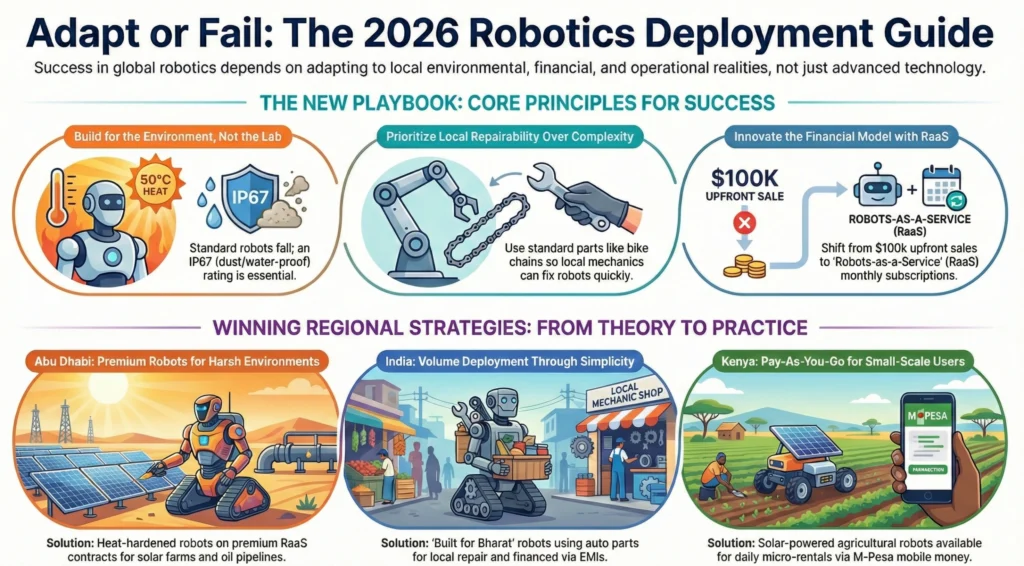
Success Factors for Robots-as-a-Service (RaaS) Deployment
1. Environmental Operating Envelope
European robots with rubber seals fail in 50°C UAE summers components melt and batteries overheat. An IP67 rating (dust-proof and water-resistant) is an absolute requirement for desert and agricultural deployments.
2. Local Repairability
If a German robot breaks in rural India, it becomes junk. Successful emerging market robots use standard automotive components bike chains, wiper motors, bearings that local mechanics can repair with basic tools.
3. Financial Model Innovation
Shift from $100,000 purchases to “Robots-as-a-Service” (RaaS). Customers pay a monthly fee ($2,000–$5,000) that includes hardware, maintenance, and support. This lowers the barrier to entry.
4. Battery Runtime & Power Infrastructure
In off-grid environments, robots must operate entirely on solar power or feature rapid battery swapping. Western designs relying on grid charging cannot function in rural Kenya.
5. Language Interface
Sophisticated robots with English-only interfaces fail where operators speak Hindi, Swahili, or Arabic. Vernacular voice interfaces represent a competitive moat as defensible as hardware patents.
6. Integration Complexity & Time-to-Value
- Industrial Arm: 6-12 months setup
- Warehouse AMR: 2-4 months setup
- Agricultural Robot: 1-2 months setup
- Faster integration = faster ROI for the client.
7. Regulatory Environment
Deploying in UAE oil facilities requires ATEX certification (explosion-proof). Without this, technical capability doesn’t matter deployment is illegal.
8. Market Maturity
Abu Dhabi companies understand RaaS. Kenyan farmers require education. Successful companies invest 20-30% of their sales cycle in customer education.
The Strategic Implication: Success depends on designing solutions that align with regional realities, not just raw technical specs.
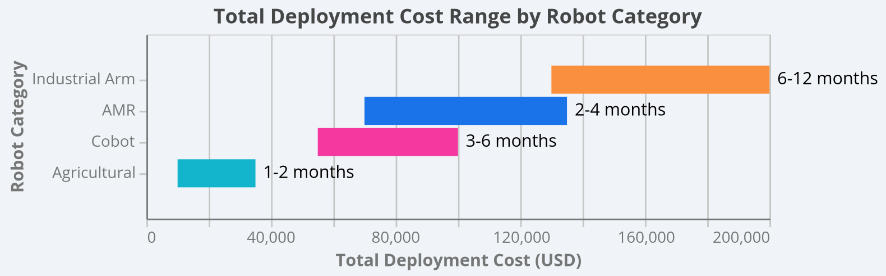
Deployment Cost Realities
| Robot Category | Hardware Cost | Integration Cost | Time-to-Value |
| Industrial Arm | $30,000-50,000 | $100,000-150,000 | 6-12 months |
| Cobot | $25,000-40,000 | $30,000-60,000 | 3-6 months |
| AMR | $20,000-35,000 | $50,000-100,000 | 2-4 months |
| Agricultural | $5,000-20,000 | $5,000-15,000 | 1-2 months |
Regional Market Strategies
Abu Dhabi – Premium Environmental Solutions
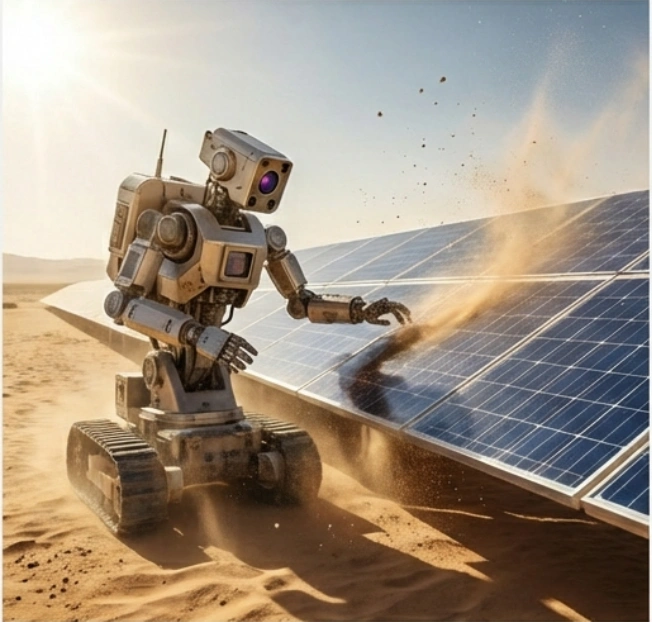
If we design robotics solutions specifically hardened for extreme desert conditions (50°C heat, persistent dust) and deliver them via RaaS subscriptions with guaranteed uptime, then we can capture premium contracts in solar maintenance and infrastructure inspection where international competitors’ temperate-climate solutions systematically fail.
The Problem: Solar farms lose 30% efficiency due to dust, and pipeline inspection in 50°C heat is dangerous for humans. ADNOC operates thousands of kilometers of pipelines across scorching desert terrain.
The Solution: Design robots hardened for 50°C heat and dust, delivered via premium Robots-as-a-Service (RaaS) contracts. Target solar panel maintenance, pipeline inspection, and vertical farming.
Key Assumption: Government entities (Masdar, ADNOC) will pay premium rates ($5k-$15k/month) for proven reliability and data sovereignty.
Validation Metrics: Secure 2-3 pilots within 6 months; achieve 95%+ uptime during summer; demonstrate 30%+ efficiency improvement.
India – Volume Deployment via Financial Innovation

If we design robots using locally sourceable automotive components for easy repair, integrate vernacular voice interfaces, and offer flexible financing (EMI, pay-per-use, subsidy navigation), then we can achieve high-volume deployment in quick-commerce warehousing and agricultural automation where upfront capital costs prevent adoption.
The Problem: Manual packing is too slow for 10-minute delivery, and small farmers (80% own less than 2 acres) cannot afford large machinery. Manual sewer cleaning remains a humanitarian crisis despite being illegal.
The Solution: “Built for Bharat” robots using standard automotive parts for local repair, funded by EMI or government subsidies. Pay-per-pick pricing (₹2/item) for warehouses.
Key Assumption: Businesses prefer “jugaad-compatible” designs with low repair costs over technically superior but fragile imports.
Validation Metrics: Deploy 50+ robots within 12 months; achieve 60%+ financing through EMI; demonstrate 24-hour local repair for 80%+ of issues.
Kenya – Pay-As-You-Grow Mobile Integration
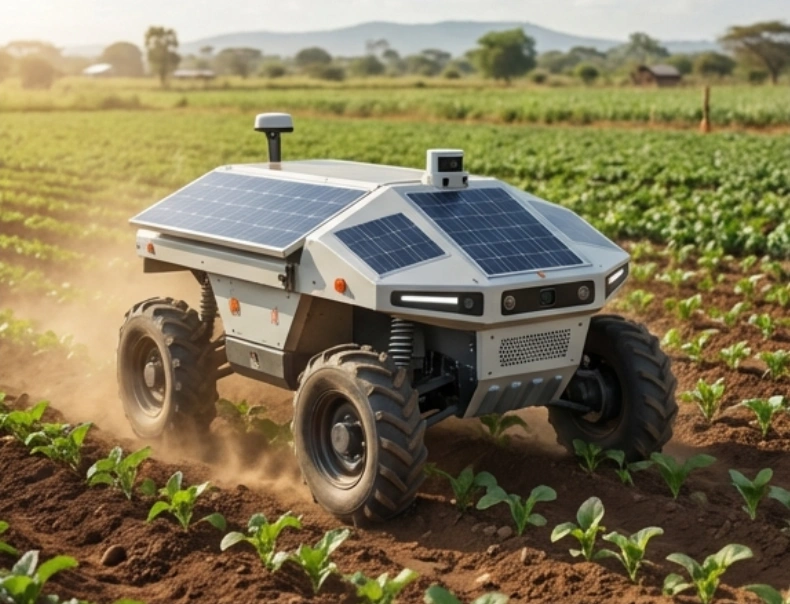
If we integrate native M-Pesa daily rental payments ($5/day), design for off-grid solar operation, and support Swahili voice interfaces, then we can enable smallholder farmer adoption where upfront capital requirements prevent technology access.
The Problem: Farmers lose crops to pests (“Armyworms”) that destroy entire corn crops in days. They cannot afford upfront technology costs. Medicine delivery fails during rainy season when roads become impassable mud.
The Solution: Solar-powered robots available for $5/day rental via M-Pesa. Agricultural monitoring robots for pest detection, cargo mules for rural logistics.
Key Assumption: Daily micro-rentals eliminate the psychological barrier of large capital costs, unlocking the smallholder market.
Validation Metrics: Achieve 200+ active daily rentals within 18 months; demonstrate 95%+ payment collection via M-Pesa; validate solar-only operation across growing season.
FAQs
Why do industrial robots fail in extreme climates?
Robots designed for temperate climates (15-25°C) fail when rubber seals soften, batteries degrade 40-50% faster, and lubricants thin out in 50°C heat. Reliable operation requires military-grade thermal management, IP67 protection, and components validated for temperature extremes.
What makes “Robots-as-a-Service” (RaaS) different?
RaaS operates like Netflix. Instead of buying a robot for $100k upfront, customers pay a monthly subscription ($2,000-5,000). The provider guarantees uptime and handles all maintenance. If the robot fails, replacement is guaranteed at no extra cost. This eliminates capital budget barriers and transfers performance risk from customer to provider.
Why can’t humanoid robots operate longer than 2-4 hours?
Humanoids pay a “standing tax” expending energy just to balance through constant micro-adjustments. Unlike wheeled vehicles with passive stability, humanoids continuously drain power. Combined with weight limits on batteries (to keep the robot agile only 1/8th of total mass), this creates a hard limit on runtime until battery chemistry fundamentally improves.
How does the “Funding Paradox” affect market opportunities?
Venture capital floods AI software platforms while hardware startups struggle. This creates opportunities for alternative funding through equity crowdfunding. Knightscope raised $70+ million from 28,000 individual investors, creating massive brand advocates. This democratised approach provides competitive advantage over traditional VC-backed competitors constrained by software-margin expectations.
What’s more important: advanced AI or environmental hardening?
Environmental hardening creates the foundation sophisticated AI is worthless if hardware fails after two weeks of dust exposure. A robot with 95% task success operating 350 days/year delivers far more value than 99% success requiring monthly repairs due to environmental failures. The optimal approach combines practical AI handling 80% of scenarios with environmental hardening ensuring continuous operation.
About Solvencis
This analysis was authored by Sreekanth P G, a Research Associate at Solvencis. In association with @dinesh Dinesh Rajan
Currently pursuing a Master of Computer Applications (MCA), Sreekanth focuses on applied robotics research at the intersection of AI, Automation and Real-world deployment. He tracks robotic systems and the way they can move beyond experimentation into scalable, cost-effective solutions across sectors such as logistics, manufacturing, and infrastructure.
At Solvencis, he focuses on MSME segment to contribute over market and technology research on robotics adoption, deployment models, and regional strategy, supporting data-driven decision-making in the evolving automation landscape of 2030
For expert business help, please contact us:
- Email: inquiry@solvencis.com