
Robotics Industry Opportunities: Global Trends & Reality Check

If you are a businessman, entrepreneur, or investor assessing the 2026 robotics market opportunities, you’ve likely encountered countless articles about humanoid robots in Tesla factories or Boston Dynamics’ impressive demonstrations.
We’ve researched the global robotics ecosystem, analyzed deployment failures and successes across emerging markets, and identified the specific factors that determine whether a robotics venture succeeds or becomes an expensive lesson in ignoring regional reality.
We’ve researched the global robotics ecosystem, analyzed deployment failures and successes across emerging markets, and identified the specific factors that determine whether a robotics venture succeeds or becomes an expensive lesson in ignoring regional reality.
The Global Robotics Landscape: Beyond American Media
The industry shows a significant disconnect between media coverage and manufacturing reality. While American media focuses on Silicon Valley, the true volume lies elsewhere. To understand the real 2026 robotics market opportunities, we must look at the global supply chain data often cited by the International Federation of Robotics.
Who Actually Builds Robots:

- China (The Volume Leader): Manufactures over 52% of global robots with more than 500,000 units produced in 2025.Companies like Unitree (the “DJI of Robotics”) are making advanced robotics affordable. Their G1 humanoid ships for $16,000 versus Western competitors at $100,000+.
- Japan (The Heart): Supplies approximately 45% of global industrial robots. Companies like FANUC and Yaskawa produce the critical precision components harmonic drives, sensors, actuators that power robots manufactured worldwide. Open any robot made in China or Germany, and the parts inside likely came from Japan.
- Germany (The Integrator): Leads in high-end engineering. KUKA and ABB represent European excellence in precision industrial automation.
- USA (The Brain): Specializes in service robots and AI algorithms rather than volume manufacturing.
Why Emerging Markets Represent Real 2026 Robotics Market Opportunities
The robotics industry stands at a critical inflection point where deployment is shifting to emerging markets. Three factors drive these new 2026 robotics market opportunities :
- Labor Cost Dynamics: Emerging markets are seeing wage increases and infrastructure development simultaneously, skipping directly from manual labor to automation.
- Infrastructure Gaps: Unreliable grids and extreme weather are not just challenges they are design opportunities. A solar-powered robot for Kenya cannot be replicated by a generic Western competitor.
- Financial Innovation: Just as Kenya pioneered mobile money, robotics offers opportunities for daily rentals via M-Pesa and government subsidy navigation innovations Western competitors cannot access.
2026 Robotics Reality: What Actually Works vs. Media Hype
The Humanoid Robot Reality Check
You may recall the 1980s sitcom “Small Wonder,” where robot Vicki performed household chores powered by fictional “atomic energy.” Fast forward to 2026, and despite billions in venture capital, humanoid robots still operate only 2-4 hours per charge and struggle with tasks as simple as folding laundry.
Major manufacturers including BMW, Mercedes-Benz, and Amazon have finally deployed humanoid robots on factory floors in 2026, marking the “Year of Deployment” a critical transition from research to commercial reality. However, this exposes technological gaps marketing materials conveniently omit.
| Company | Business Model | Primary Revenue Strategy |
| Agility Robotics | RaaS (Primary) | Subscription-based labor replacement for 3PL/Logistics. |
| Figure AI | Commercial Lease | Strategic enterprise agreements (e.g., BMW) focused on ROI-per-part-installed. |
| Apptronik | Hardware Sales / R&D | Selling a “modular platform” that customers can program for specific apps. |
| Tesla | Vertical Integration | Internal use first; future “Robot-as-a-Service” likely via the Tesla Network. |
Four Fundamental Limitations
- 1. Battery Life Bottleneck: Unlike wheeled vehicles, humanoids expend energy just to stand (“active stability”). Most operate only 90 minutes to 2 hours. A robot needing 4 hours charging for 2 hours of work cannot serve continuous operations.
- 2. The Dexterity Paradox: Human hands have ~27 degrees of freedom. Replicating this is expensive. Current grippers are either strong (lifting boxes) or delicate (picking grapes) rarely both.
- 3. The Autonomy Illusion: Many impressive demos are “teleoperated” controlled remotely by humans. True autonomy requires recovering from errors without supervision, which remains a massive challenge.
- 4. Integration Costs: Buying a robot arm costs $30,000, but programming and installing it costs $100,000. This “Integration Tax” makes automation too expensive for small businesses.
The Funding Paradox
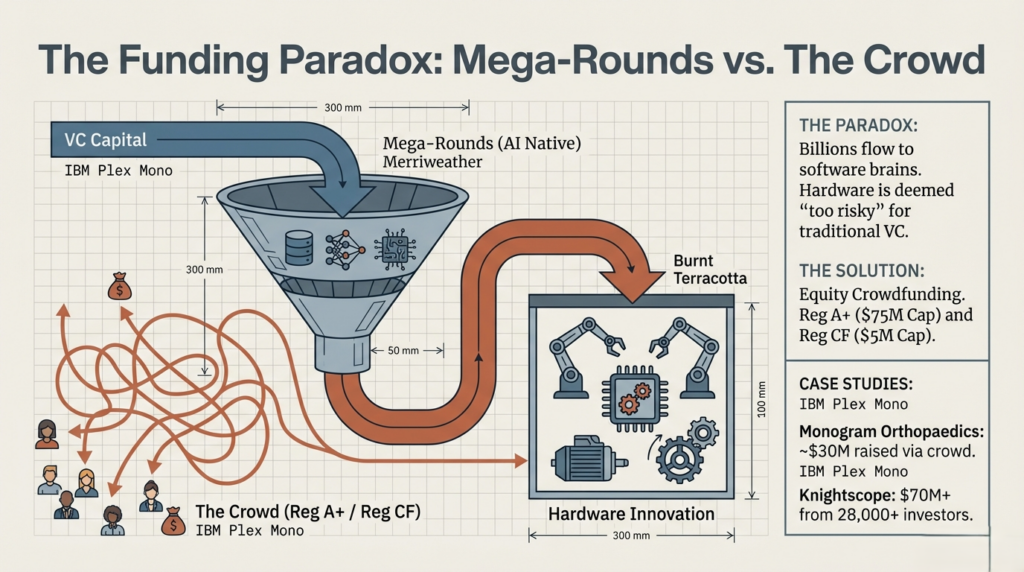
Venture capital floods AI software with “Mega-Rounds” exceeding $100 million, while hardware startups struggle to secure investment. Manufacturing requires factories, inventory, and supply chains operational complexity that software-focused investors avoid.
Hardware companies increasingly turn to equity crowdfunding. Knightscope raised over $70 million from 28,000 individual investors for autonomous security robots. This democratization creates alignment between customers and investors, as crowdfunding investors become early adopters and brand advocates.
Now that you understand the market landscape and technical reality, how do you execute? Read Next: The 2026 Deployment Playbook & Case Studies
About the Author and Solvencis
This analysis was authored by Dinesh Rajan, a Research Associate at Solvencis. In association with @sreekanth Sreekanth PG
Currently pursuing a Master of Computer Applications (MCA), Dinesh focuses on applied robotics research at the intersection of AI, Automation and Real-world deployment. He tracks robotic systems and the way they can move beyond experimentation into scalable, cost-effective solutions across sectors such as logistics, manufacturing, and infrastructure.
At Solvencis, he focuses on MSME segment to contribute over market and technology research on robotics adoption, deployment models, and regional strategy, supporting data-driven decision-making in the evolving automation landscape of 2030
For expert business help, please contact us:
- Email: inquiry@solvencis.com